
Advocate Suman Dhungana • Aug 13, 2026
As Nepal rapidly expands its digital economy, establishing secure, resilient, and standardized technology infrastructure has become a critical regulatory requirement. To ensure national data sovereignty, mitigate cyber risks, and maintain operational stability across key sectors, the Ministry of Communication and Information Technology (MoCIT) enacted the Data Center and Cloud Service (Operation and Management) Directives, 2081 (2025), the foundational data center law and cloud service law now governing this space in Nepal.
Formulated under Section 79 of the Electronic Transactions Act, 2063 (2008), these directives mandate compulsory listing, operational tier standards, continuous vulnerability management, and audit compliance for all digital infrastructure operators and cloud-reliant tech businesses in Nepal.
The Government of Nepal, Ministry of Communications and Information Technology, exercising the powers conferred by Section 79 of the Electronic Transactions Act, 2008 (2063), issued the Data Centre and Cloud Services (Operation and Management) Directive, 2025 (2081) ("the Directive") on 10 February 2025.
This comprehensive guide breaks down the statutory obligations, operational mandates, tier features, sector-specific legal implications, and cloud governance framework needed to achieve full legal compliance under Nepal's tech regulatory landscape.
Key Definitions
The Directive defines several core terms that shape how the law applies in practice:
- Cloud Services refer to the integrated technology, including both hardware and software, that enables the hosting of information processing systems developed by the government, public, or private sectors using data center services or other platforms.
- Data Centre refers to a facility equipped with the necessary infrastructure to store data and operate information technology systems developed by the government, public, or private sectors.
- Public Institution includes government-owned or funded universities, banks, research centers, and other similar entities.
- Department refers to the Department of Information Technology (DoIT), the primary regulatory and enforcement authority under the Directive.
- Center refers to the National Cyber Security Center (NCSC), the national body responsible for cyber incident response and forensic investigation.
The Multi-Tiered Legal & Regulatory Framework
The Directives establish a clear supervisory matrix across statutory bodies to oversee digital infrastructure, cybersecurity resilience, and cloud governance in Nepal:
- Department of Information Technology (DoIT): Serves as the primary regulatory and enforcement authority responsible for evaluating listing applications, conducting physical and technical infrastructure inspections, maintaining the official registry of compliant service providers, and issuing delisting orders.
- National Cyber Security Center (NCSC): Functions as the national central body overseeing technical forensic investigations, threat intelligence sharing, and cyber incident response.
- Steering Committee: A 9-member inter-ministerial body chaired by the Secretary of MoCIT that directs policy alignment, inter-agency coordination, and regulatory oversight for public and commercial IT infrastructure.
- Integrated Data Management Center (IDMC): Manages government data centers, public cloud virtualized environments, and colocation facilities housing public sector data and national security systems.
Mandatory Listing & Registration Requirements
Under Section 3, operating a data center or delivering commercial cloud service solutions without prior listing with DoIT is strictly prohibited. Companies offering both data center colocation and cloud hosting services must obtain separate listings for each service type.
Registration with the Department of Information and Technology
Entities applying to list a data center facility must submit an application in the prescribed format, along with the following documents:
- Certificate of company or firm registration
- Fire safety compliance documents
- Building construction completion certificate
- Security and privacy policy of the organization
- Business Continuity Plan documents
- Map showing the data center's location
- Details of the data center tier classification
- Technical manpower information
- Physical security methods and procedures
- IP pool ownership details
- High-level electrical design
- Contract with the building or landowner, if the organization does not own the premises
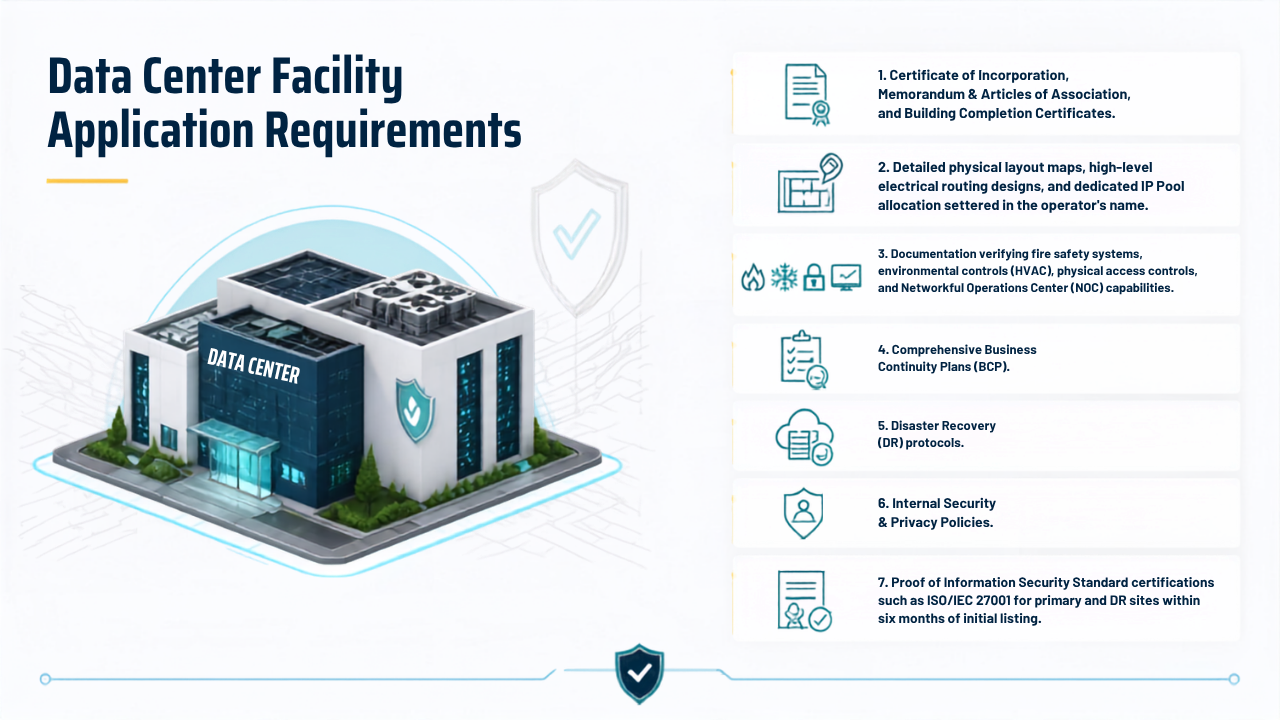
Taken together, these documents fall into seven broader categories of evidence DoIT expects to see:
- Corporate and site legitimacy: Certificate of Incorporation, Memorandum & Articles of Association, and Building Completion Certificates.
- Physical and network layout: detailed physical layout maps, high-level electrical routing designs, and a dedicated IP Pool allocation registered in the operator's name.
- Facility safety and monitoring systems: documentation verifying fire safety systems, environmental controls (HVAC), physical access controls, and Network Operations Center (NOC) capabilities.
- Business Continuity Plans (BCP): comprehensive continuity planning covering how operations continue through disruption.
- Disaster Recovery (DR) protocols: documented procedures for recovering systems and data following a major outage or incident.
- Internal Security & Privacy Policies: the organization's own governance framework for protecting data and restricting access.
- Information Security Standard certifications: proof of certifications such as ISO/IEC 27001 for both the primary site and any Disaster Recovery site, which may be submitted within six months of initial listing where not yet in place.
Application Requirements for Cloud Service Operation
Entities providing virtualised cloud services (IaaS, PaaS, SaaS) must submit an application accompanied by:
- Company or firm registration certificate
- Organization's security and privacy policy
- List of technical personnel involved in cloud service operations
- Business Continuity Plan documents
- Map of the data center where cloud services will be hosted
- Agreement with the data center
- Details of ISP/NSP affiliation
- Information on IP pool ownership
If operations are already underway, the Information Security and IT Service Management Standards certification must be submitted within six months of listing.
Existing Service Providers & Annual Filing
Service providers already in operation at the time the Directive took effect were required to apply for listing within six months. All listed Data Centers and Cloud Service Providers must also update their legal, technical, and operational records on the DoIT digital portal annually by the end of Poush. Upon successful verification, DoIT may list an eligible provider within one month of application.
Data Center Tier Classifications & Operational Benchmarks
Data centers must conduct a tier rating assessment based on physical infrastructure resilience and submit a Certificate of Tier Rating to DoIT within one year of listing. The classification follows internationally recognised standards, such as those defined by the Uptime Institute.
Criteria | Tier 1 | Tier 2 | Tier 3 | Tier 4 |
| Power & Cooling Distribution Path | 1 | 1 | 1 active / 1 alternative | 2 active |
| Redundant Active Component | N | N | N+1 | 2(N+1) |
| Redundancy Backbone | No | No | Yes | Yes |
| Redundancy Horizontal Cabling | No | No | No | Optional |
| UPS/Generator | Optional | Yes | Yes | Dual |
| Concurrently Maintainable | No | No | Yes | Yes |
| Fault Tolerant | No | No | No | Yes |
| Availability (uptime within year) | 99.671% | 99.749% | 99.982% | 99.995% |
| Maximum Downtime per Year | 28.8 hours | 22 hours | 1.6 hours | 26.3 minutes |
| Power Backup Requirement | 12 hours | 12–24 hours | 24–48 hours | 48+ hours |
Regulatory Mandate: Under the Directives, data centers hosting government systems, public sector data, or critical national infrastructure must maintain a minimum of Tier 3 rating or higher.
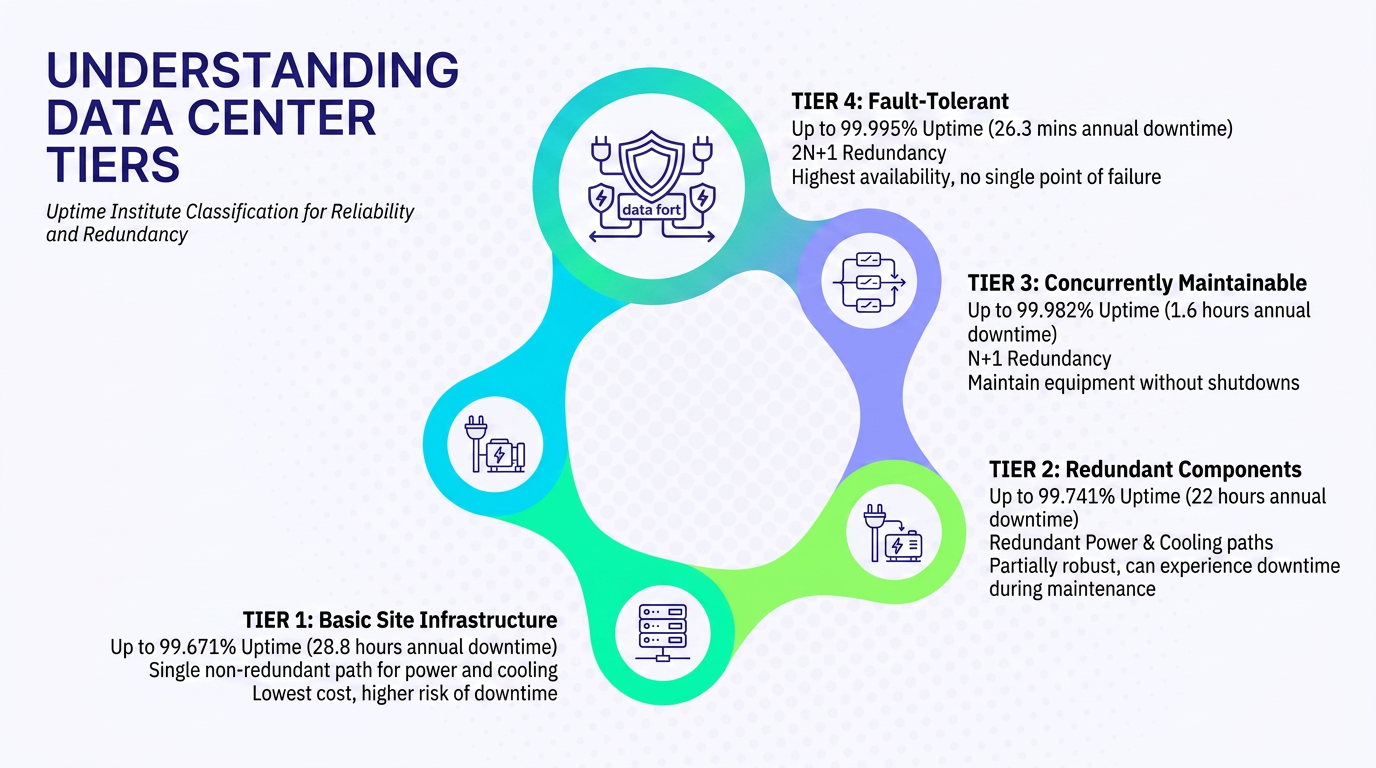
Tier 1: Basic Capacity
Tier 1 represents the most basic level of data center infrastructure.
- It operates on a single, non-redundant distribution path for both power and cooling, meaning there are no backup components built into the system
- Because there is zero redundancy, any planned maintenance or even a localized equipment failure requires taking the entire facility offline, making Tier 1 the lowest-cost option to build and operate
- It also carries the highest risk of downtime, capped at up to 99.671% uptime, or roughly 28.8 hours of potential downtime a year
- Operators are still required to maintain at least 12 hours of power backup for equipment inside the facility in the event of an electricity outage.
Tier 2: Redundant Capacity
Tier 2 builds on the Tier 1 baseline.
- It adds extra backup components, such as additional generators and chillers, giving the facility N+1 component redundancy
- This additional redundancy helps prevent single-component failures from taking the whole system down
- The power distribution lines themselves remain single-path, so planned shutdowns are still required whenever major path repairs are needed
- Tier 2 facilities have a partially robust design, with a target uptime of up to 99.749% and roughly 22 hours of permitted downtime annually, alongside 12 to 24 hours of power backup capacity.
Tier 3: Concurrently Maintainable
Tier 3 marks a significant step up in resilience.
- These facilities feature multiple independent distribution paths for both power and cooling, one active and one alternative, combined with full N+1 redundancy across active components
- The design allows any individual component or distribution path to be serviced, repaired, or replaced without requiring the facility to shut down, which is why this tier is described as "concurrently maintainable"
- Tier 3 facilities achieve up to 99.982% uptime, limiting downtime to around 1.6 hours a year, and must maintain 24 to 48 hours of power backup.
- The Directive mandates Tier 3 as the minimum standard for any data center hosting government systems or critical national infrastructure.
Tier 4: Fault-Tolerant
Tier 4 is the highest and most resilient classification under the Directive.
- It requires two active distribution paths for power and cooling simultaneously, along with 2(N+1) redundancy across all active components and dual UPS/generator systems
- Tier 4’s fault-tolerant design means the facility can absorb the failure of any single component or even an entire distribution path with no impact on operations, since there is no single point of failure.
- Tier 4 facilities are built to achieve up to 99.995% uptime, limiting annual downtime to just 26.3 minutes, and must maintain 48 hours or more of power backup.
- Given the cost and complexity involved, Tier 4 is generally reserved for the most mission-critical systems and largest commercial operators.
Responsibilities of Service Providers
Service providers carry a defined set of statutory obligations under the Directive:
- Ensure equal access to services for all clients
- Implement robust data security and privacy measures
- Prevent unauthorized access and ensure service continuity
- Report breaches immediately and take corrective action
- Appoint a Compliance Officer or partner with a certified entity
- Submit required documents to the Department on time
- Conduct annual infrastructure security audits
- Formalize cloud service agreements covering security and backups
- Comply with directives from regulatory and law enforcement bodies
- Assist in infrastructure removal or system migration when requested
- Ensure secure data transfer or destruction upon termination
Infrastructure & Operational Standards
Beyond these general responsibilities, providers must maintain specific physical and facility-level standards:
- Provide server racks, storage devices, and colocation options for clients
- Maintain firewalls, routers, switches, and a dedicated IP pool
- Ensure HVAC systems, fire safety measures, and reliable power and internet supply
- Implement an access control system, CCTV surveillance with at least 3-month retention, and visitor logs
- Employ certified or experienced technical staff
- Restrict server room access to authorized personnel only
- Securely destroy hard drives to prevent data recovery upon decommissioning
Technical Requirements for Service Providers
On the operational side, the Directive also sets out specific technical infrastructure obligations:
- Provide server racks, network equipment, servers, storage, and HVAC systems
- Ensure fire safety, physical security, and sufficient technical personnel
- Ensure reliable internet, electricity, and establish an access control system while maintaining an IP pool
- Install CCTV surveillance, store CCTV footage for 3 months, maintain visitor logs, and monitor infrastructure regularly
- Set up a Network Operations Center (NOC) to monitor network equipment
- Use security devices to protect data and offer colocation services
- Securely destroy hard disks to prevent data recovery
Removal from Listing of the Department
Section 5 outlines the conditions and procedures under which a data center or cloud service provider may be removed from DoIT's official registry.
When Can a Provider Be Delisted?
DoIT holds the authority to delist a provider under the following circumstances:
- Non-compliance: Failure to meet the terms and conditions outlined in the Directive
- Data misuse: Unauthorized handling or disclosure of stored data
- Dissolution: The company or institution is legally dissolved
- Voluntary withdrawal: The provider submits a formal request for delisting
In cases of non-compliance or data misuse, DoIT issues a 15-day show-cause notice before revoking a listing. If the response is inadequate, or no response is received, formal removal follows within 7 days, accompanied by public notices in a national daily newspaper and on DoIT's official website. Clients are legally prohibited from procuring infrastructure from unlisted vendors, so if a provider is delisted, client entities must immediately and securely migrate all applications, codebases, and databases to a compliant, DoIT-listed provider.
Compliance Requirements for Service Providers
To operate legally and securely under Nepal's cloud governance framework, service providers must maintain ongoing compliance across several areas:
- Dedicated Compliance Officer: Facilities must appoint an in-house compliance officer or partner with an authorized compliance consultancy firm.
- Annual Audits: Operators must undergo an independent security and technical audit at least once every 12 months.
- Surveillance & Destruction: CCTV surveillance logs covering physical server rooms must be stored for at least 3 months, and retired hard drives must be physically destroyed or degaussed.
- Incident Reporting: Immediate mandatory notification to DoIT and NCSC upon discovering unauthorized access or a cyber incident.
- Bilateral Agreements: Security and backup responsibilities for cloud-hosted systems must be formalised in agreements between the provider and client.
- Annual Filing: Updated legal, technical, and operational records must be submitted to DoIT by the end of Poush each year.
Sector-Specific Compliance Implications
The Directives impact businesses across digital sectors, intersecting with existing statutory rules and sector-specific guidelines:
Payment Service Providers (PSPs) & Payment System Operators (PSOs)
Under the Nepal Rastra Bank (NRB) Payment Systems Directives and Payment & Settlement Regulations, PSPs and PSOs must ensure financial transactions, wallet balances, and user KYC data reside on local servers. Under the 2081 Directives, fintech entities hosting infrastructure locally must use DoIT-listed data centers or cloud hosts. Non-listed hosting risks regulatory action from both DoIT and NRB.
Software Developers & SaaS Operators:
Software development firms providing SaaS products must evaluate their hosting arrangements. Delivering SaaS hosted on unlisted local infrastructure or non-compliant cloud platforms exposes tech platforms to listing violations, breach of client SLAs, and legal liability under the Electronic Transactions Act.
Foreign IT Multinational Corporations & Cloud Vendors
Foreign enterprise cloud vendors and international IT platforms serving Nepalese businesses must evaluate data localization requirements, cross-border data transfer limitations, and local partner agreements. Enterprise cloud agreements must incorporate custom data privacy and security terms aligning local regulatory mandates with international cloud delivery models.
IT Outsourcing Companies & Offshore Delivery Centers
IT Outsourcing (ITO) and Business Process Outsourcing (BPO) firms operating offshore delivery centers in Nepal must maintain strict client data isolation, robust Business Continuity Plans, and ISO-aligned information security frameworks. Compliance with the Directives ensures foreign clients that local delivery centers operate within a legally recognized, audit-ready environment.
E-Commerce Platforms & Online Retailers
E-commerce providers handling large volumes of customer personally identifiable information (PII), credit card details, and transaction histories are legally required under the Electronic Commerce Act, 2081 and customer procurement rules to host their digital platforms on DoIT-listed infrastructure. Service level contracts with web hosting and cloud providers must include clear indemnification, security, and data protection provisions.
Non-Banking Financial Companies (NBFCs) & Microfinance
Microfinance institutions, cooperative networks, and capital market entities hosting Core Banking Systems (CBS) or digital loan platforms must strictly adhere to data sovereignty, data backup, and physical redundancy mandates. Using unlisted local hosting providers creates compliance exposure during annual regulatory audits.
How Sherpa Law Associates Delivers End-to-End Compliance Leadership
Navigating the intersection of the Data Center and Cloud Service Directives, 2081, the Electronic Transactions Act, 2063, the E-Commerce Act, 2081, and NRB Unified Payment Directives requires targeted legal expertise.
Being a legal advisor law firm, Sherpa Law Associates provides comprehensive legal advisory, corporate structuring, and regulatory representation for tech businesses across Nepal:
- DoIT Listing & Statutory Registration: Assistance through the DoIT registration process, including drafting compliant Security Guidelines, Privacy Policies, BCP frameworks, and submission packages for DCs and CSPs.
- SLA & Cloud Contractual Engineering: Drafting, negotiating, and reviewing Service Level Agreements (SLAs), colocation contracts, SaaS vendor terms, and cross-border liability structures.
- Fintech Regulatory Alignment (PSP/PSO & NRB): Aligning IT infrastructure operations with Nepal Rastra Bank IT Directives, Payment & Settlement Bylaws, and local data hosting requirements.
- FDI, Cross-Border Structuring, & Foreign Tech Expansion: Guiding foreign IT companies and global cloud vendors on Foreign Direct Investment (FDI) approvals, joint venture structuring, and local corporate setup.
- Cybersecurity Incident Response & Audit Defense: Legal defense and executive guidance during data breach events, statutory notifications to DoIT and NCSC, and regulatory audit representation.
Frequently Asked Questions
How many data centers are there in Nepal?
There is no single official public count, since both government and private-sector facilities exist and third-party trackers vary in coverage. Nepal's core government facility is the Integrated Data Management Center (formerly the Government Integrated Data Center) at Singhadurbar, Kathmandu, with its Disaster Recovery Center located in Hetauda. Alongside this, a growing number of private data centers now operate in Kathmandu and beyond, including established Tier-2 and Tier-3 facilities, with several new large-scale projects announced in 2026 as part of Nepal's broader push to grow its data center sector.
What are the big 3 data centers?
"Big 3" most commonly refers to the three dominant global cloud providers, Amazon Web Services (AWS), Microsoft Azure, and Google Cloud, which together host a majority of the world's cloud infrastructure.
Is Google data center coming to Nepal?
Not directly, at least based on current, verified reporting. In 2026, Nepali company Bichuten Data Vault announced a Tier-4 data center project in Chobhar (Kathmandu) and Birgunj, with Google Cloud, AMD, Micron, and VVDN Technologies named as technology and strategic partners. Google Cloud's role has been clarified as providing cloud services and technical solutions, not direct capital investment, and the project's funding is domestically backed. Some early media coverage overstated this as "Google entering Nepal," which local outlets have since corrected.
Which country has the highest data center?
The United States hosts by far the largest number of data centers globally, driven by major hyperscale hubs such as Northern Virginia, alongside significant concentrations in countries like Germany, the UK, and China.
What are the current e-governance services available in Nepal?
Nepal's e-governance ecosystem, coordinated substantially through the Integrated Data Management Center (National Information Technology Center), supports a range of digitised public services, including online company registration through the Office of the Company Registrar, electronic tax filing through the Inland Revenue Department, e-Procurement through the Public Procurement Monitoring Office, court case tracking through the Supreme Court's systems, and sector-specific platforms across the Department of Foreign Employment, Ministry of Home Affairs, Department of Customs, and Ministry of Agriculture. Citizen-facing platforms such as the Nagarik App have also expanded access to several of these services directly from mobile devices.
Ensure Your Technology Operations Are Audit-Ready and Legally Secure
Do not let legal oversight disrupt your digital operations. Contact our corporate technology law practice today to structure your compliance strategy.
- Schedule a Legal Consultation: Contact Sherpa Law Associates
- Direct Helpline: +977 9846000030
Legal Disclaimer: This article is prepared for general informational purposes only and does not constitute formal legal advice. For specific legal counsel regarding technology compliance, corporate governance, or regulatory registration in Nepal, please contact the legal team at Sherpa Law Associates.