
Advocate Suman Dhungana • Oct 16, 2026
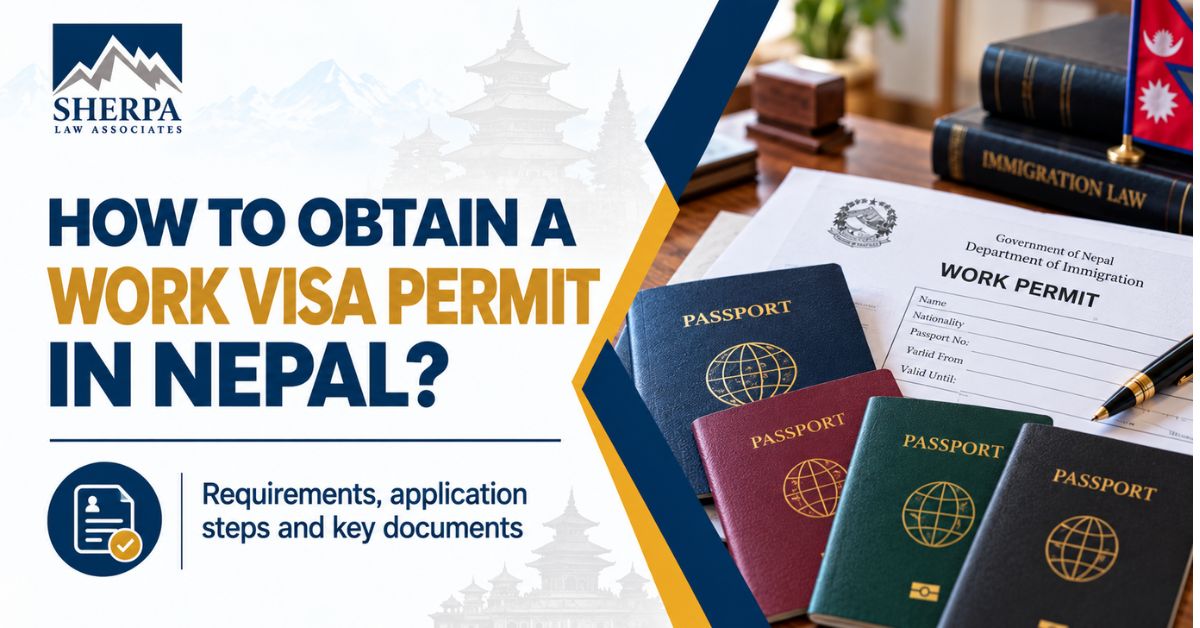
Foreign nationals generally need the applicable labour permission and a working visa before taking up employment in Nepal. A work visa permit in Nepal is not a single document issued by a single office: the employer and the employee must follow the relevant approval process, which can vary depending on the employer's legal status, the nature of the job, the project and any applicable statutory exception.
This guide covers eligibility, the government authorities involved, documents, application steps, fees, processing times, renewal and the legal risks of working without approval. It is written for foreign professionals planning a move to Nepal and for companies that want to hire them lawfully. It is general information, not legal advice for a specific case.
Key Takeaways
- A foreign national generally needs both labour permission from the Department of Labour and Occupational Safety and a working visa from the Department of Immigration before starting work. A job offer alone does not create the right to work.
- No single department finishes the process. The Ministry of Home Affairs, the relevant line ministry and bodies such as the Department of Industry or the Social Welfare Council may also be involved.
- The usual route needs a vacancy ad in a daily newspaper, but statutory exceptions exist. An exception from the recruitment procedure does not automatically exempt a national from every permit, immigration or record‑keeping requirement.
- Foreign‑invested or aid‑funded entities and short‑term technical personnel, such as those staying three months or less, have their routes, each with its own scope and conditions.
- The published labour permit fees are NPR 15,000 for up to six months and NPR 20,000 for more than six months. Working visa fees are USD 30, USD 50, or USD 75 per month depending on category, plus USD 20 for a re‑entry or USD 60 for multiple re‑entries. Confirm amounts before budgeting.
- Published timeframes apply to stages only: up to 30 days for the labour permit, about one week for the Home Affairs work approval, and same‑day visa issuance when documents are complete. These are not a guarantee of the processing time.
- The labour permit and the working visa have validity periods, so both expiry dates must be tracked. Renewal is a compliance process, not an extension.
- Employing a national without a required permit can lead to a fine of up to NPR 200,000 for the employer, plus NPR 5,000 per worker per month if the breach continues. Immigration consequences for the worker depend on the facts.
- The Department of Foreign Employment handles the employment of Nepali citizens. It does not issue work permits for foreigners working in Nepal.
- Getting the employer’s status, recommendations and documents right before applying is the most effective way to avoid delay or rejection.
What Is a Work Visa Permit in Nepal?
People often use "work permit" and "work visa" as if they were the same thing. They are not. In Nepal, you usually need both.
- A work permit (labour permit) authorises an employer to engage a particular foreign national in a particular role. It is issued under labour legislation by the Department of Labour and Occupational Safety (DoLOS).
- A working visa authorises a national to stay in Nepal for work. It is issued by the Department of Immigration under immigration law.
The two approvals are connected. The immigration authority generally expects the labour permission and the employer's supporting approvals before it issues the visa, so the employer's approval and the worker's immigration status rise or fall together.
That is also why a job offer alone does not establish the right to work. An offer letter shows intent. The right to work comes from the permits and the visa. Starting work before they are in place can expose both the employer and the worker to penalties.
Who Needs a Work Permit to Work in Nepal?
The general rule comes from Sections 22 and 23 of the Labour Act, 2074 (2017): an employer may not engage a foreign national as a worker without the required permission. Whether a particular person needs a permit still depends on what they will actually do and on any applicable exception.
In practice, the following groups usually fall within the permit requirement:
- professionals employed by Nepali companies.
- Foreign employees of companies operating in Nepal.
- Foreign nationals working on development or donor‑funded projects.
- Foreign Technical specialists working on installation, repair or other technical assignments.
- Foreign employees assigned to project offices or other authorised organisations.
When Can a Foreign National Work Without the Standard Recruitment Procedure?
Section 24 of the Labour Act and the related rules recognise some situations where the standard recruitment route does not apply, or where a simpler procedure is available. Summaries usually list:
- Executives or staff of companies that are foreign‑invested or foreign‑aided. Labour Rules let these companies hire up to three nationals only by keeping a record without putting a job ad in a newspaper.
- Technical workers who come for three months or less to fix machines, install new technology, or do similar urgent technical jobs.
- Persons covered by diplomatic immunity or a qualifying treaty or government agreement.
Please read that list carefully, because it is easy to misread. An exception from the standard recruitment or application procedure is not automatically an exemption from every work permit, immigration or record-keeping requirement. Each exception has its own scope, and you should confirm the exact procedure for your category before acting on it.
Which Laws Govern Work Permits and Working Visas in Nepal?
Several laws apply, and each one answers a different practical question.
- Labour Act, 2074 (2017): Restricts the employment of foreign nationals without the required permission, requires employers to look for local talent first, sets out statutory exceptions and regulates employment conditions.
- Labour Rules, 2075 (2018): Explain how an employer applies, what evidence to attach, the prescribed fees and how the permit process runs.
- Foreign Nationals' Labour Permit Management Directive, 2075 (2018): Provides administrative guidance for labour permission for foreign nationals. Some publications cite it as 2076, so confirm the current official version and any later changes.
- Immigration Act, 2049 (1992), and its rules: Govern the separate immigration and working visa requirements.
- Investment and sector-specific requirements: Certain employers and projects need additional approvals or recommendations before the labour process can even begin.
A quick warning: Which rule bites the hardest depends on the type of organisation and the employment arrangement. A Nepali company hiring a consultant, a foreign‑invested company, and an INGO can have different paperwork.
Which Government Authorities Issue Work Permits and Working Visas?
No single department completes the whole process, so do not assume one office will handle everything.
Authority | Role |
| Department of Labour and Occupational Safety | Administers labour permits under the applicable labour legislation. |
| Department of Immigration | Processes and issues the working visa. |
| Ministry of Home Affairs | May handle the relevant work-agreement or work-approval procedure. |
| Relevant line ministry or sector authority | Provides the recommendation or project-related approval where required. |
| Department of Industry, Investment Board Nepal or Social Welfare Council | May be involved where the organisation's investment, project or NGO/INGO status makes it relevant. |
One confusing point here needs its own line. The Department of Foreign Employment handles citizens who go abroad to work. Its job is different from getting permission for a foreign national to work inside Nepal, so it is not the office you go to for a work permit.
Types of Work Visa (Work Permit) in Nepal
In practice, labour permits follow three routes:
- Standard employment route: For Nepali employers who put a job ad and show that no qualified Nepali worker could be found.
- Foreign-invested or aid-funded entities: A simple route for eligible foreign‑invested companies, NGOs and INGOs limited to the numbers and documents the rules require.
- Technical or short-term route: For specialists who come for installation, repair or similar work lasting up to three months.
How Do You Apply for a Work Permit and Working Visa in Nepal?
Step 1: Confirm the Employer's Legal Status and the Correct Application Route
Start by working out what kind of employer you are: a Nepali company, a foreign-invested enterprise, an NGO or INGO, a government project or another eligible organisation. That decides your route.
Also, look for any company registration, investment, project or sector approval. Applying for a labour permit before the employer has its legal basis is a common reason for delays.
Step 2: Obtain the Required Recommendation and Work Approval
Next, identify the concerned ministry or authority and obtain the recommendation or work-agreement approval required for your category. Where the Ministry of Home Affairs process applies, its published guidance directs applicants to contact the relevant ministry and submit the recommendation and supporting documents through the prescribed route.
Step 3: Complete the Required Recruitment Process
Under Section 22 of the Labour Act, the standard route generally requires a vacancy advertisement in a national daily newspaper. The employer must document the recruitment effort and show that the required skilled worker could not be supplied from among Nepali citizens, as applicable.
Statutory exceptions may apply to specified technical personnel, experts or approved projects, so the advertisement is not an absolute rule for every case. Confirm which side of that line you are on.
Step 4: Submit the labour permit Application
The employer submits the application and supporting evidence to the Department of Labour and Occupational Safety under the applicable rules. In practice, that means:
- Completing the prescribed application.
- Submitting employer and employee details.
- Providing the required recommendation, recruitment evidence and supporting documents.
- Paying the labour permit fee.
- Responding to any requests for information.
- Receiving the labour permit or another relevant approval.
You can find guidance on the DoLOS website.
Step 5: Apply for the Working Visa
Once the labour permission and other prerequisites are in hand, the foreign national or an authorised representative follows the Department of Immigration's working visa procedure. The application starts on the Department of Immigration's online working visa portal, and the supporting documents must accompany it.
An online application does not necessarily mean the whole process happens online. Recommendations, approvals, original-document checks or other formalities may still be required.
Step 6: Pay the Applicable Visa Fee and Obtain the Visa
The working visa fee depends on the category and the period approved. Confirm the current amount, re-entry options and payment procedure with the Department of Immigration. Once the visa is issued, check its validity, authorised purpose and conditions before you begin work.
Step 7: Keep the Approval Records and Start Work Only When Authorised
Both the employer and the foreign employee should keep copies of the labour permit, visa, work agreement and related approvals. Work should begin only when every required permission is in place, and the worker must stay within the approved role, employer and period.
What Eligibility Requirements Must the Employer and Foreign Employee Meet?
Employer Requirements
- The organisation must have a legally recognised basis to conduct the relevant activity in Nepal.
- The company or project must hold the necessary registration, investment approval, project agreement or other applicable authorisation.
- The proposed position and employment arrangement must be consistent with the organisation's approved activities.
- The employer must provide the supporting documents and recommendations required for its specific route.
- Where the standard recruitment procedure applies, the employer must demonstrate that qualified Nepali workers could not be recruited through the prescribed process.
Foreign Employee Requirements
- A valid passport and appropriate immigration status.
- A genuine employment offer, appointment or contract appropriate to the case.
- Relevant professional qualifications or technical expertise where required.
- A role consistent with the proposed work permit application and recommendation.
- Compliance with the relevant visa and labour permit conditions.
Does the Company Need FDI Approval to Hire a Foreign Worker?
Not necessarily, and it would be wrong to present FDI approval as a universal requirement. Approval is relevant to many foreign-invested companies, but the legal route depends on the organisation's structure, registration, project arrangements and the employee's role. Companies set up through foreign direct investment in Nepal usually have extra approvals and reporting to handle alongside the labour process.
The sector matters well. Enterprises that fall under law in Nepal, such as manufacturing businesses licensed through the Department of Industry, may require an industry recommendation before the labour permission step.
A foreign company operating only from overseas should not assume it can sponsor an employee in Nepal. It needs a local legal or project basis first, and a corporate law firm in Nepal can help structure the entity, the investment and the employment arrangement before any permit application starts.
What Documents Do You Need for a Work Visa Permit in Nepal?
The precise list varies by employer category and approval route, so treat this as a practical starting checklist, not a guaranteed complete one.
Documents the Employer Should Prepare
- Company registration certificate or relevant project agreement.
- PAN/VAT registration and applicable tax-clearance documents.
- Appointment letter, employment contract or work agreement.
- Job description, position, salary and employment period.
- Evidence of the recruitment process, including the national newspaper vacancy advertisement and supporting evidence where required.
- Recommendation letter from the concerned ministry or authority, including the approved period, where applicable.
- Relevant foreign investment, industry, project or organisational approvals.
- Other supporting documents, which are requested by the competent authority.
Documents the Foreign Employee Should Prepare
- Valid passport copy.
- Current Nepal visa and relevant visa-history copies.
- Professional qualifications, certificates or experience records where required.
- Employment contract or appointment letter.
- Online working visa application and supporting documentation.
- Any additional documents requested for the specific case.
Additional Documents for NGOs, INGOs and Project-Based Employment
Depending on the organisation and its legal status, you may also need the relevant recommendation, project agreement or Social Welfare Council documentation. The Department of Immigration lists a recommendation letter, work or labour permit, work agreement, appointment or contract letter, relevant tax-clearance documents and a valid passport among its working visa requirements.
Can You Apply for a Work Permit or a Working Visa Online in Nepal?
Partly. The government provides systems and application information, but the labour permit process and the working visa process are separate, and the online portal for one does not complete the other. Searches such as " work permit application Nepal" or "labour permit Nepal online" can make it sound like a single online form. It is not.
Use these official resources:
- Department of Labour and Occupational Safety: labour permit information and official guidance.
- Department of Immigration, working visa information: Requirements and application information on the website.
- Department of Immigration Work Permit System: The official portal displaying company registration and sign-in options.
Before you start, verify that the relevant portal supports your specific application type and whether the process needs separate approvals or in-person formalities. If you only want to check a permit's status or confirm what has been recorded, the same official portals are the place to look, so keep your login details and application numbers safe. That is how most applicants check a work permit online in Nepal.
How Much Does a Work Visa Permit Cost in Nepal?
These are the published government figures. Confirm the current amounts before you budget.
Item | Reference fee |
| Labour permit, up to six months | NPR 15,000 |
| Labour permit, more than six months | NPR 20,000 |
| Working visa | USD 30, USD 50 or USD 75 per month, depending on the published category |
| Single re-entry | USD 20 |
| Multiple re-entry | USD 60 |
The labour permit fees come from Rule 10 of the Labour Rules 2075. Some publications quote figures, which is another reason to verify against the current official source. For visas, the USD 75 monthly rate is generally quoted for foreigners working in Nepal in the standard category. Lower categories exist, for example, for staff of offices or projects directly affiliated with the Government of Nepal and for workers in donor‑funded organisations, so the category that applies to you matters.
On top of the government charges, expect costs for document preparation, translation or certification, legal assistance and other case‑specific administrative expenses. Legal fees are not government charges, and the total will differ between applicants depending on the permit duration, visa duration, category and any additional approvals.
How Long Does It Take to Obtain a Work Visa Permit in Nepal?
Published timeframes exist for individual stages, but there is no single guaranteed total:
- Labour permit: Rule 8 of the Labour Rules provides a decision framework of up to 30 days for a satisfactory application, subject to the applicable procedure.
- Work approval: The Ministry of Home Affairs states that its relevant work‑approval process can take around one week after registration once all required documents have been received.
- Working visa: The Department of Immigration FAQ states that issuance can occur on the day when the required application and documents are complete.
These are stage-specific figures, not a promise of total processing time. Allow extra time for recruitment advertising, ministry recommendations, document corrections, project approvals and any additional scrutiny. A realistic plan starts the process well before the intended start date.
How Long Does a Work Permit or Working Visa Remain Valid?
Permit duration and visa validity are separate, and you must track both.
- The labour permit runs for the period stated in the approved permit and work agreement. Published guidance describes permits as typically issued for no more than one year at a time with renewal.
- Skilled workers and other foreign workers are treated differently by the rules. Skilled foreign workers have a shorter employment period limit. One summary says the cap for foreign workers is five years renewals included. Check the rule that applies to your role.
- The working visa is valid for the period stated on the visa itself.
You need valid permission throughout employment. Do not assume that every permit lasts one year, or that a worker automatically qualifies for five years of employment. And remember that the visa's expiry date and the permit's expiry date can differ.
How Do You Renew a Work Permit and Working Visa in Nepal?
Renewal is a compliance process, not an automatic extension. A sensible approach:
- Check both the permit and visa expiry dates.
- Confirm that the employment and the employer's legal status remain valid.
- Prepare updated employment, company, tax-clearance and recommendation documents as applicable.
- Submit renewal applications to the relevant authorities within the applicable time.
- Obtain the renewed approvals before continuing employment beyond the authorised period.
- Update the records if the job, employer, project or employment duration changes.
On timing, some published guidance advises applying at least 30 days before expiry. Treat that as a cautious planning point and confirm the current deadline under the applicable rules and procedure, because a universal annual deadline is not something we can state without legal support. Renewal fees are generally published as matching the fee for the relevant duration.
What Happens If a Foreign National Works Without the Required Permit or Visa?
The consequences can be serious, though they depend on the facts.
- For employers: The Labour Act includes a penalty for employing a foreign national without the required permission. Published summaries describe a fine of up to NPR 200,000 based on the number of workers, plus a further NPR 5,000 per worker per month if the unauthorised employment continues after the penalty. Confirm the current operative wording and enforcement provisions before relying on those figures.
- For workers: Where a visa does not authorise the activity, or the worker otherwise breaches immigration conditions, immigration consequences can follow.
- Practical fallout: Interruption of employment, difficulty obtaining future approvals and extra compliance costs.
We would not say that every violation automatically leads to deportation. Immigration consequences depend on the facts and the applicable law. If a foreign national has already started work or has an expired permit or visa, get case-specific legal advice quickly, because early correction usually costs less than late correction.
How Can a Legal Firm Help You Obtain a Work Visa Permit in Nepal?
Sherpa Law Associates is a Kathmandu law firm established in 2020 and based in Anamnagar, with licensed advocates advising foreign nationals and companies on business, immigration and compliance matters. As one of the best legal firms in Kathmandu handling both corporate and visa work, we help with practical steps such as:
- Reviewing the employer's legal structure and eligibility.
- Identifying the correct labour permit and working visa route.
- Reviewing recruitment documents and employment agreements.
- Coordinating the relevant ministry recommendation and supporting documentation.
- Preparing and reviewing applications.
- Advising on fees, timelines, renewal and compliance obligations.
- Assisting with complex cases involving foreign investment, project agreements, NGOs/INGOs or technical personnel.
A lawyer cannot guarantee government approval, and no reputable adviser will promise one. What we can do is reduce avoidable errors in documents, sequencing and compliance, and help you plan realistically.
Obtain Legal Assistance for a Work Visa Permit in Nepal
If you are a foreign national planning to work in Nepal, or a company hiring international employees, for help with eligibility, labour permission, working visa applications, document review and renewals. We assess your specific circumstances and identify the applicable process before you commit to a timeline or budget.
To help us assess your case quickly, it is useful to tell us:
- What sector or industry the foreign company is in (for example, IT, hydropower or an NGO).
- Whether the company is registered in Nepal with FDI or is operating through a short-term contract.
Contact Sherpa Law Associates for any legal assistance with your work visa permit in Nepal.
Frequently Asked Questions About Work Permits in Nepal
How do foreigners get a work permit in Nepal?
The employer goes to the Department of Labour and Occupational Safety with the recommendation, evidence of recruitment and supporting documents and pays the fee that is required. Once the labour permission is approved, the foreign worker then applies for a working visa at the Department of Immigration. The exact route depends on whether the employer's a registered legal entity and on the type of job.
Can a company sponsor a foreign worker in Nepal?
Not in the way "sponsorship" works in some countries. In Nepal, the employer applies for labour permission on behalf of the worker, and the worker then applies for the visa. The employer must be a legally recognised organisation with the necessary registrations and approvals, and a company with no local legal or project basis cannot simply sponsor someone.
Can I apply for a work visa online in Nepal?
You can begin the working visa application using the Department of Immigration’s portal. The process is not completely online. First, you need the recommendation, labour permission and other approvals. Some steps still require you to go in person.
Who issues work permits and working visas in Nepal?
The Department of Labour and Occupational Safety issues labour permits. The Department of Immigration issues the working visa. Other bodies, such as the Ministry of Home Affairs and the relevant line ministry or sector authority, may also give approvals and recommendations.
Does a foreign company need FDI approval to hire an employee in Nepal?
Not always. Many foreign‑invested companies need FDI approval. It is not mandatory for every employer. A foreign company that does not have a legal office or a local project should not assume it can hire in Nepal. The correct path depends on the company’s structure, registration and the worker’s role.
Can a foreign national work in Nepal on a business visa?
Generally, no. A business visa is meant for investors and business activity, and it does not by itself authorise employment. If you will be employed, you need labour permission and a working visa.
Can I change my tourist visa to a working visa in Nepal?
A tourist visa does not allow work, and working on one is a breach. Where the labour permission and other prerequisites are in place, a change of visa category can be possible. For a visa conversion process, you should confirm the procedure for your case before relying on it.
What is the minimum salary for a foreign worker in Nepal in 2026?
We are not aware of a separate published minimum salary for foreign workers. The general minimum remuneration rules under the labour legislation apply, and the job description, salary and employment period form part of the permit application. Confirm the current minimum remuneration and any category-specific requirements before you finalise the contract.
Is the Department of Foreign Employment responsible for work permits for foreigners working in Nepal?
No. The Department of Foreign Employment manages the outbound foreign employment of Nepali citizens. Work permits for foreign nationals employed inside Nepal come from the Department of Labour and Occupational Safety, and the visa comes from the Department of Immigration.
Disclaimer: This article is for general informational purposes only and does not constitute legal advice, solicitation or advertising. Laws, fees and procedures can change, so please verify the current position with the relevant authorities or consult a licensed advocate before acting. Reading this article does not create a lawyer-client relationship with Sherpa Law Associates.