
Advocate Suman Dhungana • Aug 5, 2026
As Nepal strengthens its anti-money laundering and counter-financing of terrorism (AML/CFT) framework to meet international FATF/APG standards, statutory scrutiny extends far beyond traditional commercial banks. Non-Banking Financial Institutions (NBFIs)—including Payment Service Providers (PSPs), Payment System Operators (PSOs), Remittance Companies, Hire Purchase Companies, digital wallet platforms, asset managers, insurance firms, and securities market intermediaries—are now directly in the crosshairs of regulatory enforcement, making guidance from a compliance services law firm in Nepal essential.
Supervised primarily by Nepal Rastra Bank (NRB) and the Financial Intelligence Unit (FIU-Nepal), non-banking financial entities face rigorous compliance mandates under the Asset (Money) Laundering Prevention Act, 2064 (as amended 2080) and the Asset Laundering Prevention (First Amendment) Rules, 2082. Failure to establish operational compliance frameworks leaves board members and executive committees exposed to severe regulatory sanctions, license revocations, and criminal liability. Engaging an experienced corporate law firm in Nepal early can help boards put compliant governance structures in place before regulators intervene.
This article provides a comprehensive legal breakdown of AML/CFT duties for NBFIs in Nepal, sector-specific directives, statutory reporting thresholds, and a blueprint for building an audit-ready internal compliance infrastructure.
1. The Legal & Regulatory Statutory Framework
AML/CFT compliance for non-banking entities in Nepal is governed by a hierarchy of statutes, regulations, and sector-specific regulator directives:
- Foundational Act: Asset (Money) Laundering Prevention Act, 2064 (2008) – Establishes money laundering offenses, customer due diligence duties, and the FIU-Nepal reporting architecture.
- Governing Regulation: Asset Laundering Prevention Rules, 2082 – Details procedural obligations, threshold rules, and internal control expectations.
- Fintech & Payment Systems (PSP/PSO): NRB Payment System Department AML/CFT Directives – Enforces transaction limits, eKYC integration, and wallet monitoring rules.
- Remittance Companies: NRB Foreign Exchange Management Department AML/CFT Directives – Governs money changers, remittance flows, payout verification, and sub-agent controls.
- Hire Purchase Companies: NRB Bank and Financial Institution Regulation Department AML/CFT Directives – Mandates source-of-down-payment checks and asset financing oversight.
- Capital Market Intermediaries: SEBON AML/CFT Directives for Securities Brokers and Related Companies – Standardizes risk profiling for brokerages, merchant banks, and investment managers.
Who is Designated as a "Reporting Entity" (RE)?
Under Section 2(y) of ALPA 2008, a Reporting Entity includes any business conducting financial transfers, remittance, asset financing, payment processing, or securities trading. Registered entities are formally maintained under the goAML Directory of Reporting Members.
2. Sector-Specific Compliance Duties Across NBFIs
Reporting Entities must comply with statutory pillars tailored to their specific operational risk exposure under Nepalese law:
A. Risk-Based Customer Due Diligence (CDD) & eKYC
Under Section 3 and Section 7 of ALPA, anonymous accounts or transactions under fictitious names are strictly illegal.
- Remittance Companies: Must perform strict sender and beneficiary identification prior to payout under the Remittance AML/CFT Guidelines. For cross-border inflows tied to foreign investment in Nepal that exceed prescribed thresholds, agents must verify the relationship between sender and receiver.
- Hire Purchase Companies: Must conduct thorough source-of-funds verification on cash down-payments under the Hire Purchase AML Directives.
- Payment Service Providers (PSPs/PSOs): Must apply digital KYC and automated transaction limits per the PSP/PSO AML Framework.
- Securities Brokers: Must track beneficial ownership and trading volumes in accordance with SEBON AML Directives.
- Ultimate Beneficial Ownership (UBO): Entities must identify and verify the natural person who ultimately owns or controls a corporate client (at the 25% ownership or voting control threshold).
B. Screening Against International & National Sanctions
NBFIs must implement automated daily screening of their customer bases, remitters, beneficiaries, and asset buyers against:
- UN Security Council Consolidated Sanctions Lists.
- Domestic Sanctions and Terrorist Watchlists designated by the Ministry of Home Affairs / Foreign Exchange Management Department.
C. Statutory Transaction Reporting to FIU-Nepal
All NBFIs listed on the goAML Directory must report directly through the goAML Portal operated by FIU-Nepal within Nepal Rastra Bank.
| Report Type | Statutory Trigger / Threshold | Filing Deadline |
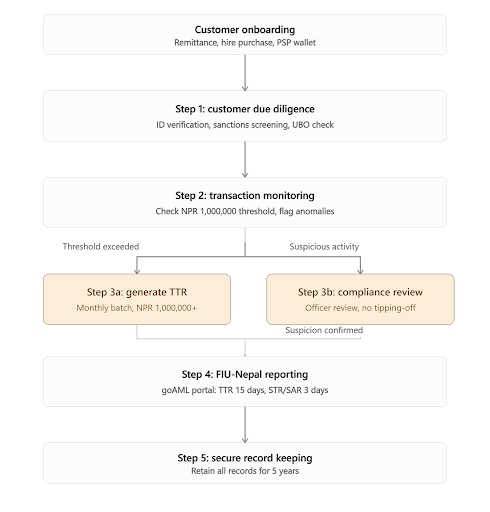
| Suspicious Transaction Report (STR) / Suspicious Activity Report (SAR) | Any transaction, remittance flow, down-payment, or attempt that raises suspicion of proceeds of crime, regardless of amount. | Within 3 working days of determining suspicion. |
| Threshold Transaction Report (TTR) | Cash transactions, single remittance payouts, or vehicle down-payments exceeding prescribed limits (e.g., NPR 1,000,000+). | Within 15 days from the end of the transaction month. |
Critical Rule: Section 10 of ALPA strictly prohibits "Tipping-Off." A Reporting Entity, its directors, remittance agents, or employees must never inform a customer or third party that an STR/SAR has been or will be submitted to FIU-Nepal. Breach of this provision carries direct criminal penalties.
3. End-to-End AML/CFT Compliance & Reporting Flow
The following graph illustrates how transaction monitoring, internal compliance review, and goAML reporting flow within a non-banking financial entity in Nepal:
- Note on Entity-Specific Thresholds: Statutory threshold limits for Threshold Transaction Reports (TTR) and daily transaction caps are not uniform across all entities. Specific thresholds vary depending on the nature, operational scale, and regulatory directives governing each entity type:
- Payment Service Providers (PSPs) & Payment System Operators (PSOs): Governed by NRB Payment System Department directives, which enforce specific per-transaction, daily, and monthly wallet transfer limits alongside electronic transfer threshold reporting rules.
- Remittance Companies: Governed by NRB Foreign Exchange Management directives, with specific thresholds applying to inward remittance payouts (e.g., single or series of inward transfers exceeding NPR 1,000,000 in a day).
- Hire Purchase Companies: Subject to NRB BFI Regulation Department directives, where specific thresholds trigger mandatory source-of-funds verification for large cash down-payments or lump-sum loan settlements.
Securities Brokers & Asset Managers: Subject to SEBON directives enforcing transaction thresholds linked to capital market settlement accounts and high-value share trading activities.
4. Statutory Penalties for Non-Compliance
Enforcement under the Asset Laundering Prevention Act, 2064 and sector directives carries severe consequences:
- Monetary Fines: Administrative fines ranging from NPR 1,000,000 to NPR 50,000,000+ depending on the severity, sector, and recurrence of the breach.
- Regulatory Sanctions: Suspension or permanent cancellation of operating licenses (e.g., revocation of PSP/PSO licenses or remittance permits by NRB).
- Criminal Liability: Under Section 30 of ALPA 2008, individuals (including directors, executive officers, remittance agents, and compliance leads) who knowingly aid, abet, or fail to implement statutory reporting obligations face imprisonment terms ranging from 2 to 10 years alongside asset forfeiture.
Strengthen Your NBFI’s Compliance Architecture
As supervisory bodies intensify goAML audits and NRB compliance inspections across remittance operators, hire purchase firms, payment processors, and securities brokers, proactive legal governance is essential to safeguard your institution’s license, reputation, and leadership.
Sherpa Law Associates, recognized as one of the best law firms in Nepal for financial regulatory matters, delivers specialized legal counsel and regulatory advisory services for non-banking financial entities, payment processors, remittance firms, hire purchase companies, and asset managers across Nepal.
Our AML/CFT legal services include:
- Drafting board-approved AML/CFT policies and Enterprise Risk Assessments for NBFIs.
- Evaluating eKYC, CDD, and goAML reporting protocols against NRB and SEBON Directives.
- Conducting independent legal compliance audits and mock regulatory inspections.
- Advising executive committees during FIU-Nepal inquiries and regulatory investigations.
Ensure your institution is fully protected and audit-ready.
Schedule a Consultation with Our Corporate Legal Team or contact us directly at +977 9846000030.
Disclaimer: This article is for general informational purposes only and does not constitute legal advice. For specific guidance and professional consultation regarding your institution's compliance obligations, please contact the legal professionals at Sherpa Law Associates.