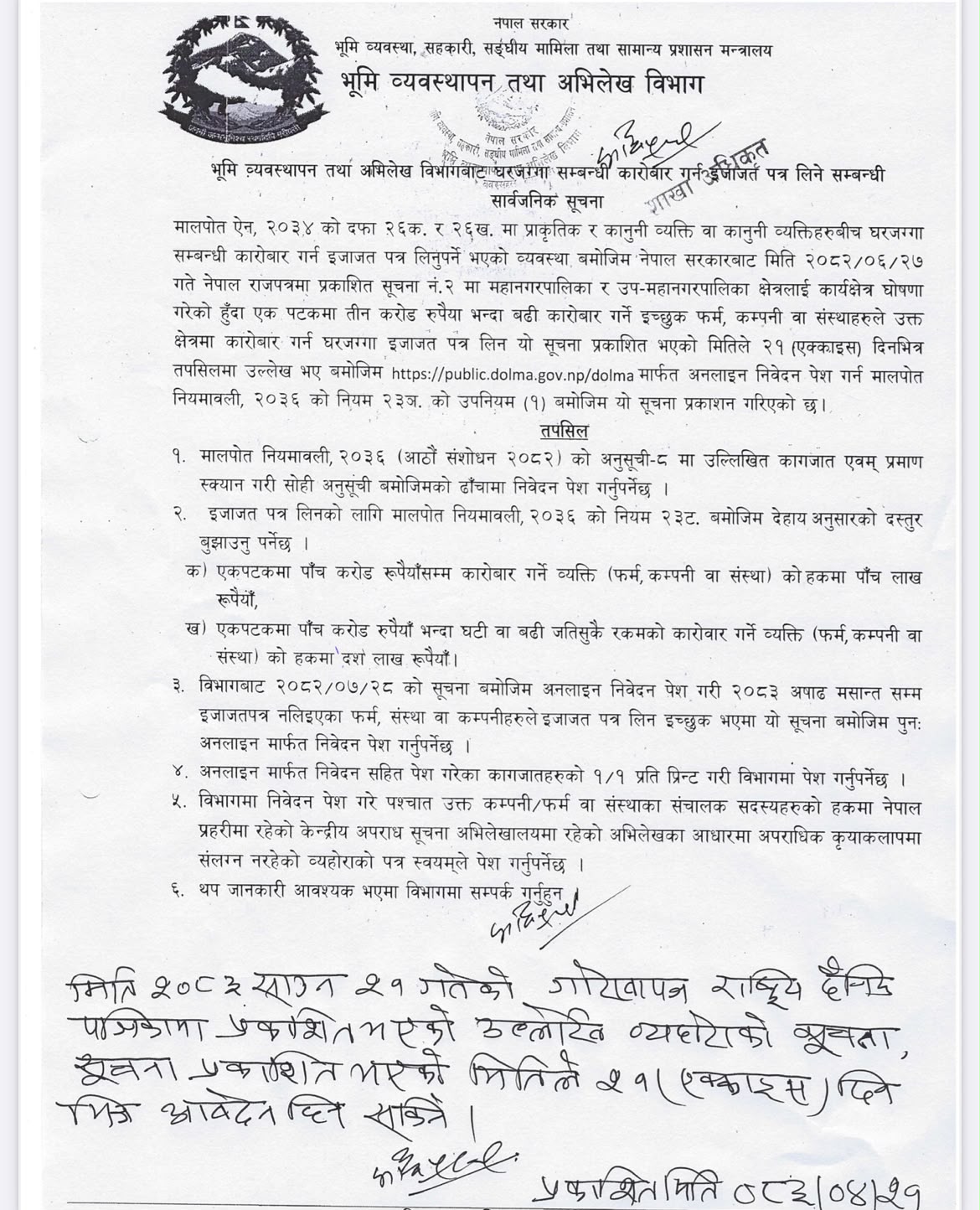

The Government of Nepal has formally introduced a mandatory licensing system for individuals and institutions engaged in land and housing transactions. This new requirement was enforced through the Land Revenue (Eighth Amendment) Regulations, 2082, published in the Nepal Gazette (Volume 75, No. 27) on Bhadra 12, 2082 BS.
The amendment operationalizes Sections 26A and 26B of the Act and incorporates two new rules Rule 23J and Rule 23K into the Land Revenue Regulations. With these changes, Nepal has officially entered the implementation phase of real estate licensing, making it compulsory for anyone wishing to conduct property transactions to obtain a Real Estate License before engaging in business.
This article provides a simplified yet comprehensive explanation of the requirements.
1. Application for Real Estate License (Rule 23J, Section 26A)
Any natural or legal person intending to conduct real estate transactions must apply for a license in the format prescribed under Schedule–8 (अनुसूची–८).
The application must be submitted to the designated authority such as local, provincial, or federal authorized under Section 26B(1).
Before issuing the license (Schedule–9 format), the authority conducts an inquiry into the applicant’s credibility, financial capacity, and business preparedness. Only applicants who meet the required standards will be licensed.
Businesses intending to operate within the regulated real estate sector should understand the complete licensing process before applying. Our detailed guide to real estate license in Nepal explains the eligibility requirements, application process, licensing fees, renewal and ongoing compliance obligations.
2. Required Documents (Schedule–8 Application Requirements)
A complete application must include:
1. Company Registration Certificate with real estate–related objectives